 EN
EN

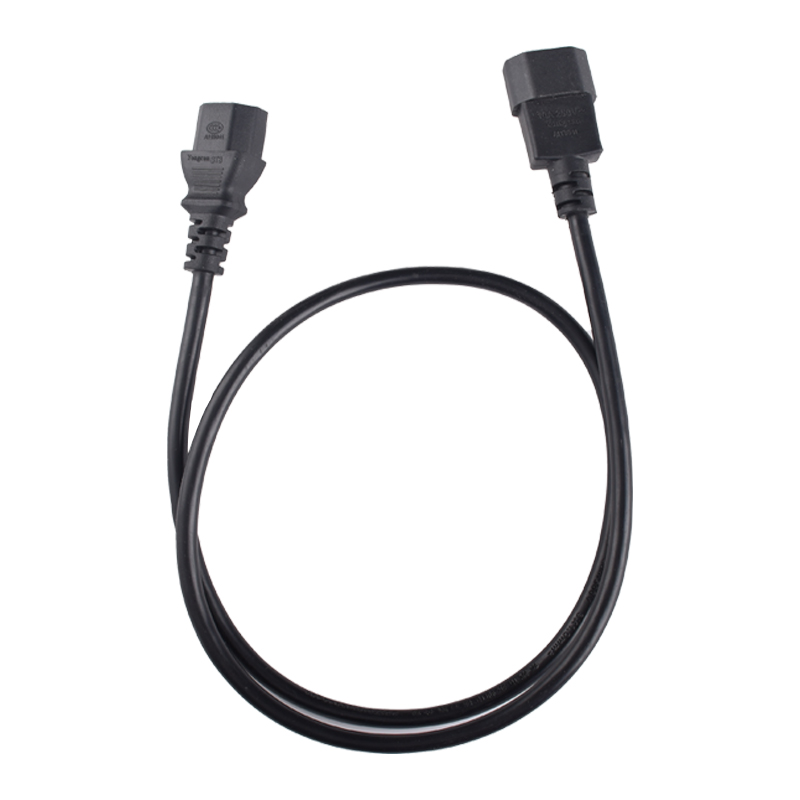
IEC 60320-1 Compliance and the Standard C13 Power Cable Gauge Range
The IEC 60320-1 standard defines the C13 connector’s physical dimensions and temperature rating up to 70 degrees Celsius, but does not specify a required wire gauge. Instead, safety standards govern conductor sizing: UL 817 mandates a minimum of 18 AWG or 0.75 square millimeters for 10-ampere-rated C13 power cord assemblies in North America. Yet most manufacturers default to 16 AWG or 1.0 square millimeters as the de facto standard—delivering improved heat dissipation, mechanical robustness, and margin against voltage drop under real-world conditions. While an 18 AWG cord may meet 10-ampere ratings in open-air testing, its effective ampacity drops significantly when bundled or deployed in warm, confined spaces like server racks. In contrast, 16 AWG maintains thermal headroom and supports stable operation across typical IT environments, including servers, switches, and power distribution units, while remaining fully compliant with global safety regulations.
For demanding deployments, such as extended cable runs, high-density rack configurations, or elevated ambient temperatures, custom C13 power cords are available in gauges from 14 AWG or 2.0 square millimeters down to 18 AWG. Though the C13 connector remains rated for 10 amperes, or up to 15 amperes in certain 125-volt configurations, thicker conductors reduce resistance, limit heating, and improve long-term reliability. The table below compares key electrical characteristics across the common custom range:
| Wire Gauge (AWG) | Cross-Section (mm²) | Resistance (Ω/1000 ft) | Ampacity (30 °C, open air) | Voltage Drop at 50 ft, 10 A |
| 14 AWG | 2.0 mm² | 2.5 Ω | 15 A | 1.8 % |
| 16 AWG | 1.0 mm² | 4.0 Ω | 10 A | 2.8 % |
| 18 AWG | 0.75 mm² | 6.4 Ω | 10 A (derated) | 3.5 % |
A 50-foot or 15-meter 14 AWG C13 power cable delivers a voltage drop below 2 percent, comfortably within the plus or minus 5 percent tolerance recommended by the Information Technology Industry Council for sensitive electronics, which is critical when powering high-density servers or power distribution units in hot aisles. Custom options also include 14 AWG conductors with 105-degree Celsius insulation, meeting UL 62 requirements for elevated-ambient applications. This full-gauge flexibility allows system designers to match each C13 power cable precisely to its electrical, thermal, and spatial constraints.
Derating Realities: Why 16 AWG C13 Power Cable May Not Sustain 10A Continuously Under Enclosed or Elevated-Temperature Conditions
While the National Electrical Code Table 310.16 lists 16 AWG copper wire with 60-degree Celsius insulation at 10 amperes under ideal free-air conditions, real-world installation drastically reduces usable ampacity. In dense data center environments, where cables are bundled and ambient temperatures reach 40 degrees Celsius, the combined derating effect is substantial. A 40-degree ambient applies a 0.91 correction factor; adding a bundling factor of 0.80 for 4 to 6 conductors drops the effective rating to just 7.3 amperes, well below the C13 connector’s 10-ampere rating. This mismatch risks sustained conductor overheating, insulation degradation, and premature failure. Thus, even though 16 AWG is widely used, it cannot reliably sustain 10 amperes continuously in enclosed, high-temperature, or bundled scenarios without compromising safety or longevity.
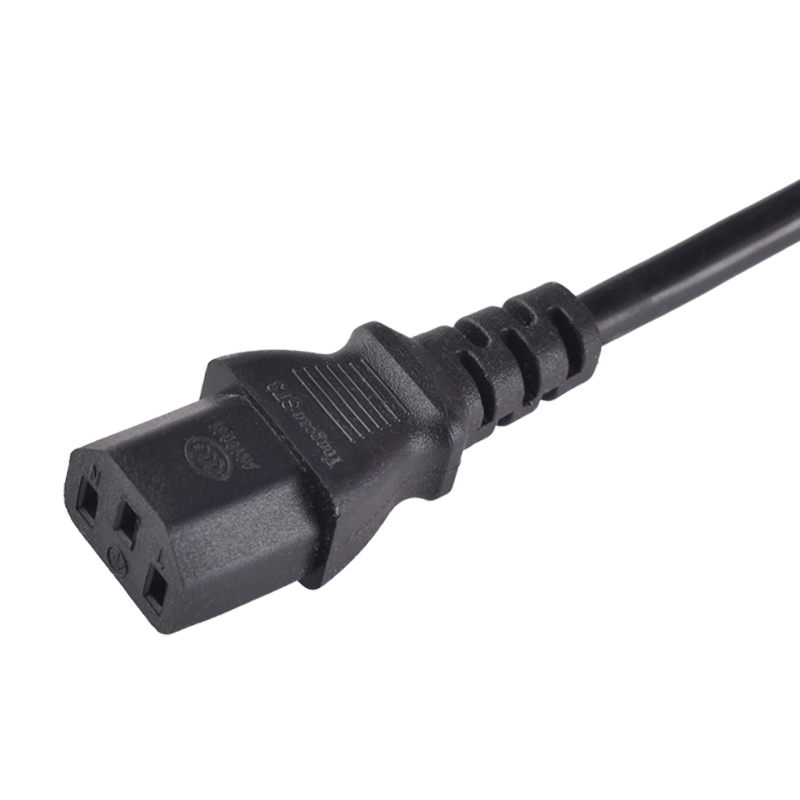
Voltage drop becomes critical as C13 power cable length increases. Using 16 AWG copper at approximately 4.02 ohms per 1000 feet, a 50-foot run carrying 10 amperes at 120 volts incurs roughly a 4.0-volt or 3.3 percent drop, exceeding the National Electrical Code 3 percent recommendation for branch circuits. At 100 feet, the drop reaches 8.0 volts or 6.7 percent, risking instability or shutdown of sensitive IT equipment. Switching to 14 AWG at approximately 2.53 ohms per 1000 feet cuts the 50-foot drop to 2.5 volts or 2.1 percent, restoring compliance and resilience. For runs exceeding 25 feet, or where equipment operates near its power threshold, 14 AWG is strongly advised; in extreme cases, 12 AWG may be warranted. Designers must perform voltage-drop calculations early in specification to ensure stable, code-compliant power delivery.
UL, CE, and CCC Certification Requirements for Non-Standard Gauges in IEC 60320 C13 Power Cable Assemblies
Custom-gauge C13 power cable assemblies must satisfy distinct regional certification frameworks: Underwriters Laboratories in North America, CE marking in Europe, and China Compulsory Certification in China. Although the IEC 60320-1 standard caps the C13 connector at 10 amperes, UL 60320-1 permits 15-ampere certification if the assembly uses adequately sized conductors, such as 14 AWG, and passes full-load temperature-rise testing. CE marking requires adherence to the Low Voltage Directive, EMC Directive, and cable-specific standards like EN 50525 for insulation performance. CCC certification under GB 2099.1 demands dielectric withstand testing at 1,500 volts AC and rigorous thermal cycling validation. Non-standard gauges require supplemental evidence: traceable lab test reports documenting temperature rise, voltage-drop modeling, flame-retardant jacket compliance like UL VW-1 or EN 60332-1, and material certifications, all essential to demonstrate conformity and uphold safety margins.
Choosing the optimal wire gauge balances safety, performance, and regulatory alignment. The standard C13 connector is rated for 10 amperes, but actual current capacity depends on conductor size, length, bundling, and ambient conditions. Use the following guidance to match gauge to application:
| American Wire Gauge (AWG) | Cross-Section (mm²) | Typical Ampacity (at 60°C) | Recommended Application |
| 18 AWG | 0.75 mm² | 10 A | Standard office equipment, short runs up to 1.5 meters |
| 16 AWG | 1.0 mm² | 13 A | Higher-power devices, moderate lengths from 1.5 to 3 meters |
| 14 AWG | 2.0 mm² | 15 A | High-current loads, long runs exceeding 3 meters, or confined, high-temperature zones |
When routing cables through tight bundles, vertical cable managers, or hot-aisle environments, prioritize lower AWG numbers to mitigate voltage drop and thermal stress. Always verify that your selected gauge aligns with both the end equipment’s certification scope and local electrical codes, particularly where continuous load, ambient temperature, or bundling factors apply. Thoughtful gauge selection ensures reliable, code-compliant power delivery while preserving safety margins across the full operational lifecycle.
Frequently Asked Questions
Q: What is the standard wire gauge for C13 power cables?
A: The standard wire gauge for C13 power cables is typically 16 AWG or 1.0 square millimeters, though 18 AWG or 0.75 square millimeters may also be used for lower-current applications.
Q: Why might I choose a custom wire gauge for C13 power cables?
A: Custom wire gauges, such as 14 AWG or 2.0 square millimeters, are chosen for high-load or extended cable applications, where minimizing voltage drop and ensuring heat dissipation are critical.
Q: What is voltage drop, and how does it affect power cable selection?
A: Voltage drop refers to the reduction in voltage along a cable length due to electrical resistance. Excessive voltage drop can lead to equipment shutdowns or instability, making larger gauge wires essential for longer runs or high-power devices.
Q: Can C13 power cable assemblies support more than 10A?
A: While IEC 60320 caps the C13 connector at 10 amperes, assemblies using 14 AWG conductors and adequate testing can be certified for 15 amperes in specific configurations.
Q: What certifications apply to C13 power cables?
A: Certifications like UL for North America, CE for Europe, and CCC for China ensure compliance with regional safety standards, particularly for non-standard configurations.